
Why do intelligent people come to completely different conclusions about the same events?
Why do misleading ideas spread so easily, even when the facts are available?
Why do some narratives feel convincing regardless of whether they are true?
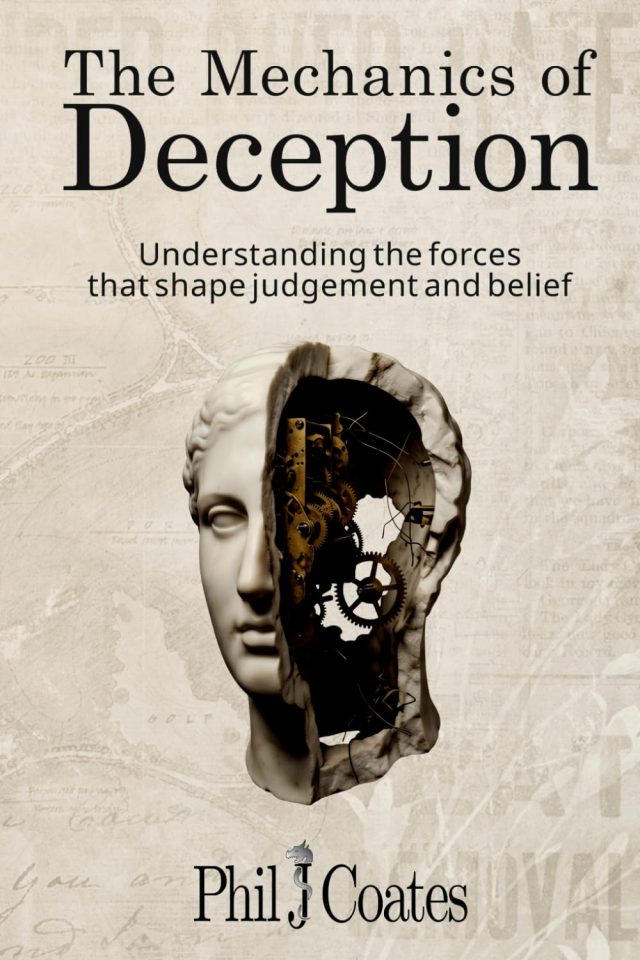
Mechanics of Deception explores the forces that shape perception, judgement and belief. From personal relationships to workplaces, institutions, politics, media and social networks, Phil Coates examines the mechanisms that influence what we notice, what we ignore and how we interpret the world around us.
Rather than focusing on individual lies or grand conspiracies, this book investigates the underlying processes that make deception possible: attention, framing, omission, narrative, authority, statistics, incentives and more. These mechanisms operate at every scale of human life. They can be used deliberately, but they can also emerge naturally from systems, organisations and human psychology.
Drawing on examples from everyday experience as well as public life, Mechanics of Deception offers readers a practical framework for recognising influence, questioning assumptions and developing clearer judgement.
This is not a book about becoming cynical. It is a book about becoming more aware.
In a world saturated with information, recognition may be one of the most important skills we can develop.